
The best solar charge controllers for boats help regulate power from solar panels before it reaches the batteries. Choosing the right controller means checking your solar panel output, battery voltage and chemistry, and whether you need to charge one battery bank or two.
In this guide, we compare four solar charge controllers from Victron, Renogy, EPEVER, and Morningstar. The picks include three MPPT controllers for different array sizes and a dual battery PWM controller for boaters who want to charge separate house and starting batteries.
Disclosure: Boat Gear Pilot may earn a commission when you buy through our Amazon or eBay links, at no extra cost to you. Our product selections and recommendations are based on the features and fit described in this guide.
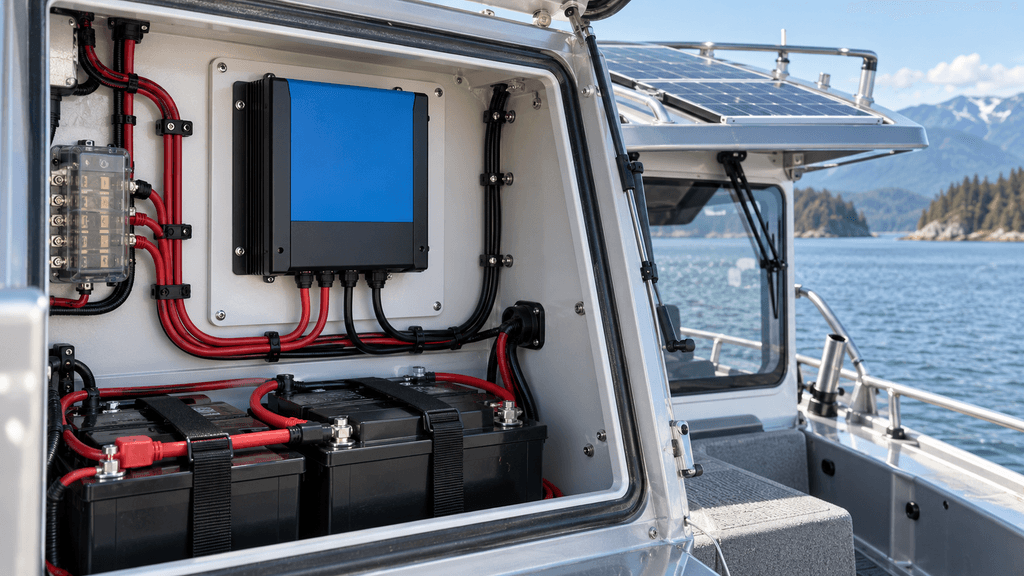
Table of Contents
Quick Picks
| Product | Best For | Standout Feature |
|---|---|---|
| Victron SmartSolar MPPT 100/30 | Best Overall | Bluetooth monitoring and 30A charging |
| Renogy Rover Li 40A MPPT | Larger Solar Arrays | 40A charging capacity and built-in display |
| EPEVER Tracer3210AN G3 30A MPPT | Best Value MPPT | 30A charging with an LCD display |
| Morningstar SunSaver Duo SSD-25RM | Two 12V Batteries | Charges separate house and starting batteries |
1. Victron Energy SmartSolar MPPT 100/30 — Best Overall
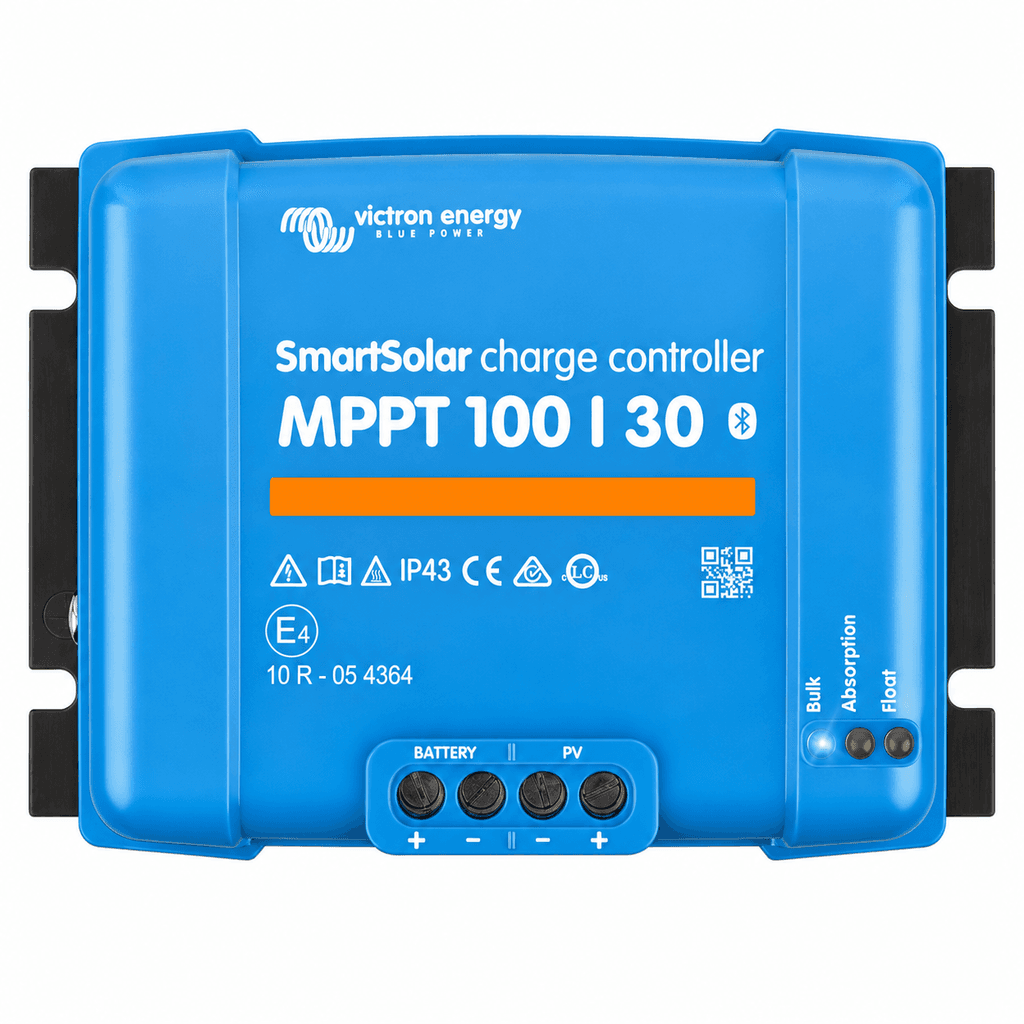
The Victron Energy SmartSolar MPPT 100/30 is a strong choice for boaters who want to monitor solar charging from their phone. Built-in Bluetooth connects to the VictronConnect app, where you can check charging performance and adjust settings without adding a separate display.
This controller supports 12V or 24V battery systems, with a maximum solar input voltage of 100V and a maximum charging current of 30A. For a boat installation, check your solar array’s open-circuit voltage and your battery’s charging requirements before choosing it. Mount the controller in a suitable protected location with the clearance specified by Victron.
Why We Like It
The SmartSolar 100/30 combines useful charging capacity with straightforward monitoring. Being able to check solar output and change settings through the VictronConnect app is especially handy when the controller is mounted out of sight in a boat compartment.
Key Features
- MPPT solar charging
- 30A maximum charging current
- 100V maximum solar input voltage
- Supports 12V and 24V battery systems
- Built-in Bluetooth for monitoring and setup through VictronConnect
Best For
Boaters with a 12V or 24V battery system who want a 30A MPPT controller and the convenience of checking their solar charging from a phone.
Pros & Cons
Pros
- Built-in Bluetooth monitoring
- Works with 12V and 24V battery systems
- VictronConnect makes settings and charging data easy to access
Cons
- 30A output may be too small for larger solar arrays
- No built-in screen; viewing detailed data requires the app or a separate display
2. Renogy Rover Li 40A MPPT — Best for Larger Solar Arrays
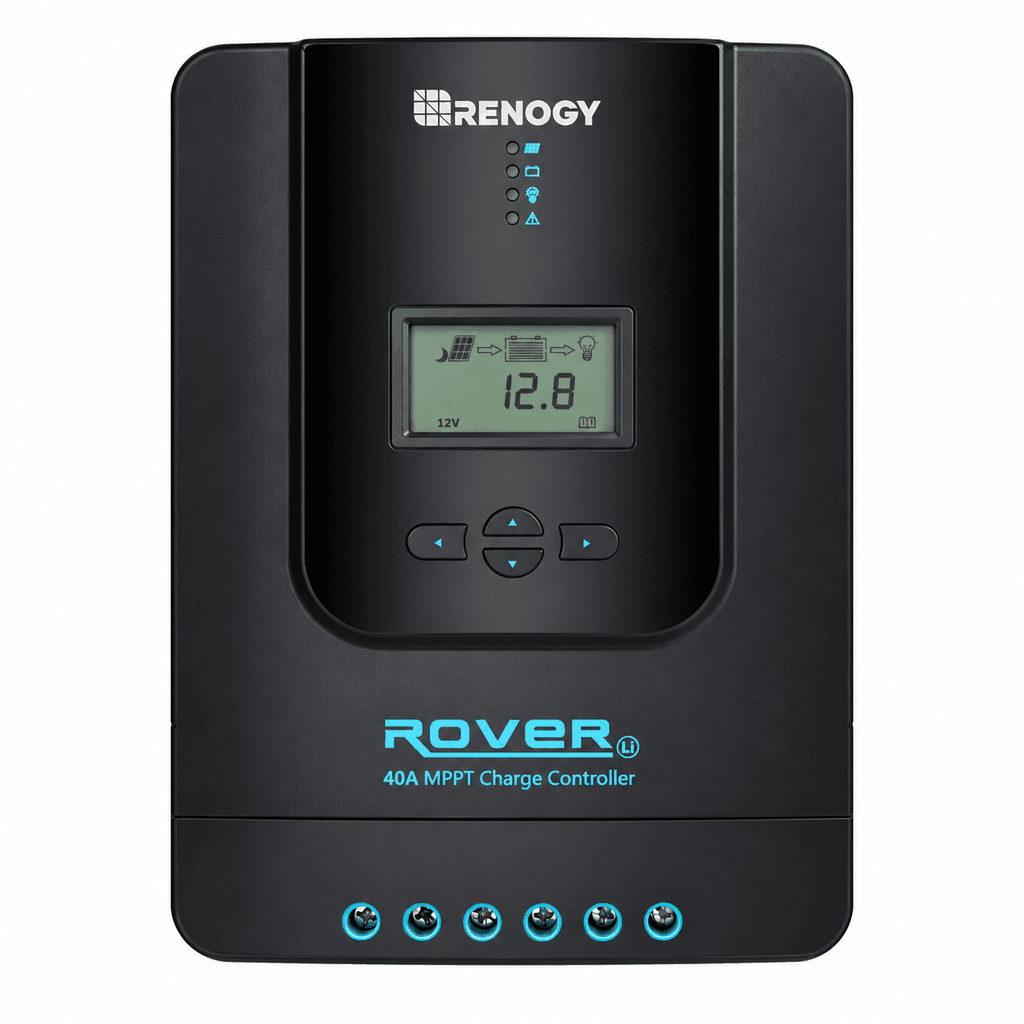
The Renogy Rover Li 40A is an MPPT solar charge controller for boaters who need more charging capacity than a 30A model provides. Its built-in LCD shows system information at the controller, which is useful if you prefer checking charging status without opening an app.
It works with 12V and 24V battery systems and offers charging settings for several battery types, including lithium batteries. The controller is a practical option when you plan to expand your solar array, provided your panels, battery bank, and wiring stay within Renogy’s limits for the 40A model. Bluetooth monitoring requires a compatible add-on module.
Why We Like It
The Rover Li 40A offers room for a larger solar setup while keeping basic charging information visible on its built-in screen. Its adjustable charging settings make it useful for boaters planning a battery upgrade, as long as the selected settings match their battery manufacturer’s requirements.
Key Features
- 40A maximum charging current
- MPPT solar charging
- Supports 12V and 24V battery systems
- Built-in LCD for charging information
- Adjustable settings for supported lead-acid and lithium batteries
- Optional Bluetooth monitoring with a compatible module
Best For
Boaters building a larger 12V or 24V solar setup who want 40A MPPT charging and a built-in screen for checking system status.
Pros & Cons
Pros
- 40A charging capacity suits a larger compatible solar array
- Built-in LCD shows charging information at the controller
- Supports 12V and 24V systems
- Adjustable settings for supported battery types
Cons
- Bluetooth monitoring requires a separate compatible module
- Larger housing needs more mounting space than compact controllers
3. EPEVER Tracer3210AN G3 30A MPPT — Best Value MPPT

The EPEVER Tracer3210AN G3 offers 30A MPPT charging with a built-in LCD, giving boaters a way to check system information directly at the controller. It supports 12V and 24V battery systems and accepts a solar array with an open-circuit voltage within its 100V limit.
Its common negative design may suit some boat electrical layouts, but that detail needs to be checked against your existing wiring. The controller also provides settings for supported lead-acid and lithium batteries. Before installing it, confirm the exact G3 version, battery settings, panel voltage, and mounting location for your setup.
Why We Like It
The Tracer3210AN G3 combines 30A MPPT charging with an LCD for checking system status at a glance. It gives boaters who want a screen on the controller a practical alternative to app-based monitoring.
Key Features
- 30A maximum charging current
- MPPT solar charging
- Supports 12V and 24V battery systems
- 100V maximum solar input voltage
- Built-in LCD for system information
- Common negative design
- Charging settings for supported lead-acid and lithium batteries
Best For
Boaters who want a 30A MPPT controller with a built-in display and a common negative design that fits their boat’s electrical setup.
Pros & Cons
Pros
- Built-in LCD shows charging information
- Supports 12V and 24V battery systems
- Common negative design may suit compatible boat wiring
- Adjustable charging settings for supported battery types
Cons
- 30A charging limit may be too low for a larger solar array
- Model versions and optional accessories can vary between listings
4. Morningstar SunSaver Duo SSD-25RM — Best for Two 12V Batteries
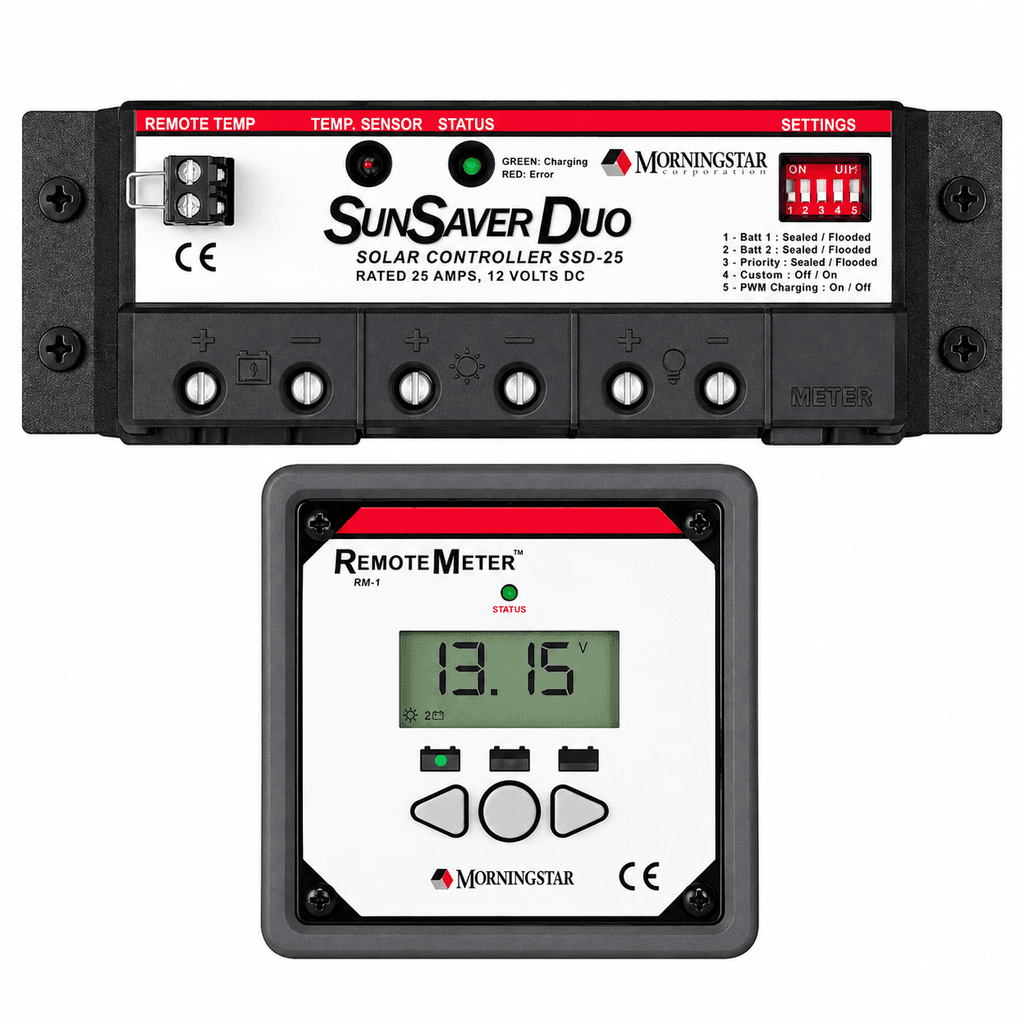
The Morningstar SunSaver Duo SSD-25RM is designed to charge two separate 12V batteries from one solar array. That makes it useful for a boat with a house battery and a starting battery. The controller lets you choose how solar charging is shared between them, and this version includes a remote meter for checking system status.
The SunSaver Duo uses PWM charging rather than MPPT, so compare its solar panel requirements with your planned array before choosing it. Morningstar specifies this model for supported sealed and flooded lead-acid batteries. Check battery chemistry, panel voltage, and wiring requirements carefully if your boat uses a different battery setup.
Why We Like It
The SunSaver Duo addresses a common boat setup: separate house and starting batteries that both need solar charging. Its adjustable charging priority and included remote meter make it easier to manage and monitor those two batteries from one controller.
Key Features
- Charges two separate 12V batteries from one solar array
- 25A maximum charging current
- PWM charging
- Adjustable charging priority between the two batteries
- Includes a remote meter with the SSD-25RM version
- Supports specified sealed and flooded lead-acid batteries
Best For
Boaters with separate 12V house and starting batteries who want to charge both from one compatible solar array and monitor them with a remote meter.
Pros & Cons
Pros
- Charges two separate 12V batteries
- Adjustable charging priority
- Remote meter included with the SSD-25RM version
- Designed for marine and RV applications
Cons
- PWM charging may harvest less power than MPPT with some solar panel setups
- Intended for compatible 12V lead-acid battery systems; confirm suitability before using lithium batteries
- Maximum solar input voltage is 30V
How to Choose a Solar Charge Controller for Your Boat
Start with your batteries and solar panels. The controller must support your battery voltage and chemistry, and its charging current must be suitable for the size of your solar array. Check the panels’ combined open-circuit voltage, including how voltage can rise in cold weather, against the controller’s maximum solar input voltage.
Next, decide how you want to monitor charging. Some controllers have a built-in screen, some use a phone app, and others offer a separate remote meter. If your boat has separate house and starting batteries, check whether the controller can charge both; most single-output models are intended to charge one battery bank.
MPPT vs. PWM
An MPPT controller adjusts its operation to draw usable power from the solar panels as conditions change. It is often the better fit when panel voltage is substantially higher than battery voltage or when getting more energy from limited mounting space matters.
A PWM controller is simpler, but it needs a suitably matched solar panel and battery setup. The Morningstar SunSaver Duo is a PWM option chosen here for its ability to charge two separate 12V batteries. Compare your panel specifications with the manufacturer’s limits before selecting either type.
Installation Considerations
Choose a mounting location that meets the controller manufacturer’s requirements for ventilation, moisture protection, and distance from the batteries. Use wire and circuit protection sized for your specific equipment and follow the manufacturer’s connection order.
Check grounding requirements carefully, particularly on a boat with an existing electrical system. If you are unsure how the solar charging circuit should connect to your batteries or other chargers, have a qualified marine electrician review the installation.
Frequently Asked Questions
Do I need a charge controller for a solar panel on my boat?
For a typical boat solar setup that charges a battery, yes. A charge controller regulates charging and helps prevent the solar panel from overcharging the battery. Choose a controller compatible with your panel and battery specifications.
Can one solar charge controller charge my house and starting batteries?
Some controllers can, but many charge only one battery bank. The Morningstar SunSaver Duo is designed to charge two separate 12V batteries. Check the controller’s instructions before connecting it to two batteries.
Can I use a solar charge controller with a lithium battery?
Only if the controller supports your battery type and can be set to the charging values required by the battery manufacturer. Check both manuals, including any requirements for temperature protection or a battery management system.
Final Verdict
The best solar charge controller for your boat depends on your solar array, battery setup, and how you want to monitor charging.
The Victron SmartSolar MPPT 100/30 is our best overall pick for its 30A charging capacity and built-in Bluetooth. Choose the Renogy Rover Li 40A if you need more charging capacity and want an onboard display. The EPEVER Tracer3210AN G3 offers another 30A MPPT option with an LCD, while the Morningstar SunSaver Duo SSD-25RM is the choice here for charging separate 12V house and starting batteries.
If you’re building out the rest of your system, start with our Best Solar Panels for Boats in 2026 guide. You can also compare storage and monitoring options in Best Marine Batteries for 2026 and Best Marine Battery Monitors for 2026.
Before buying, confirm the controller’s battery compatibility, maximum solar input voltage, charging current, and installation requirements against the equipment on your boat.