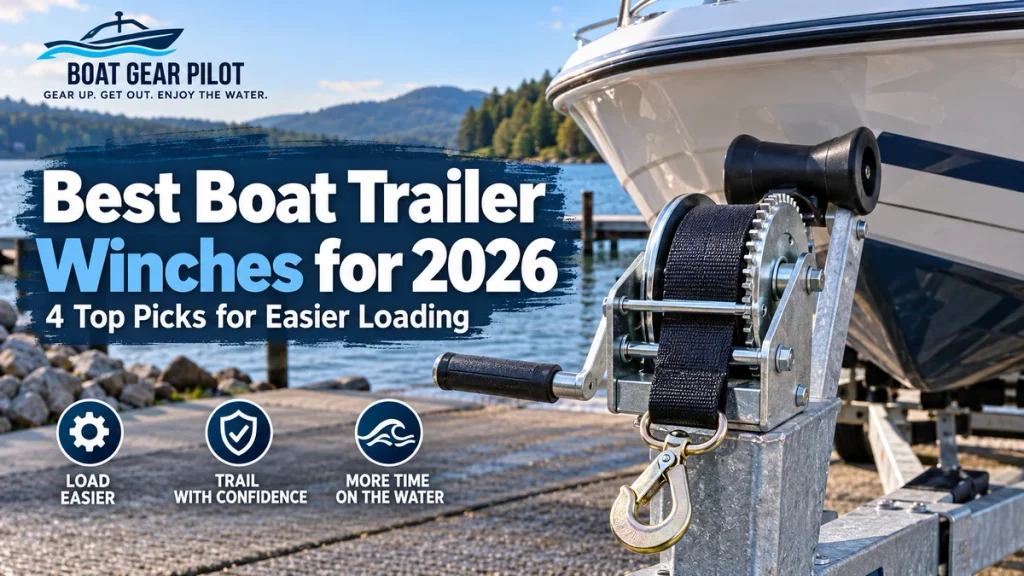
Loading a boat at the end of the day shouldn’t turn into a wrestling match at the ramp. A properly sized boat trailer winch gives you the mechanical advantage needed to pull your boat onto the bunks or rollers while keeping the loading process controlled.
The best boat trailer winch isn’t necessarily the model with the highest capacity. Boat weight, trailer design, ramp angle, gearing, strap length, corrosion resistance, and how often you launch all matter.
For this guide, we compared current boat trailer winches based on rated capacity, gearing, line or strap setup, ease of use, marine suitability, owner feedback, product availability, and overall value.
Our four picks cover very different needs—from an affordable 2,000-pound manual winch for lighter boats to two-speed manual models and a 12-volt electric option for boaters who want to reduce cranking effort.
Affiliate Disclosure
Boat Gear Pilot participates in the Amazon Services LLC Associates Program and the eBay Partner Network. We may earn a commission from qualifying purchases made through links on this page, at no additional cost to you.
Our recommendations are based on product specifications, available owner feedback, product availability, value, and how well each product fits common boating and trailering needs.
Quick Picks: Best Boat Trailer Winches for 2026
| Product | Best For | Rated Capacity | Type |
|---|---|---|---|
| Better Boat 3,200-lb Two-Speed Winch | Best Overall | 3,200 lb | Manual, Two-Speed |
| AC-DK 3,500-lb Two-Speed Winch | Best Heavy-Duty Value | 3,500 lb | Manual, Two-Speed |
| Nilight 3,500-lb Electric Winch | Best Electric | 3,500 lb | 12V Electric |
| Camco 50000 2,000-lb Winch | Best Budget | 2,000 lb | Manual |
1. Better Boat 3,200-lb Two-Speed Boat Trailer Winch — Best Overall
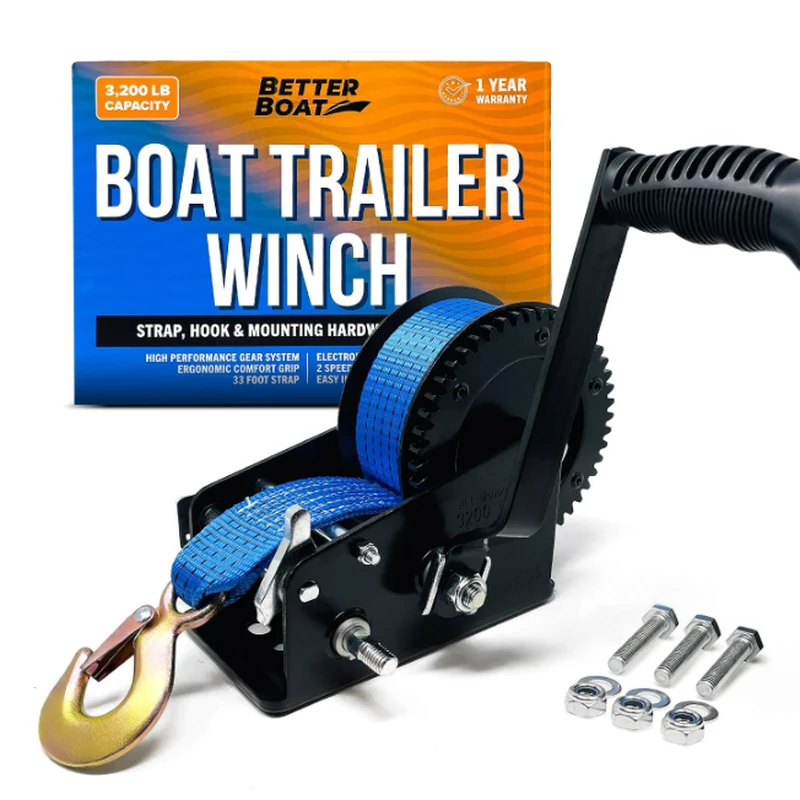
The Better Boat 3,200-lb Two-Speed Boat Trailer Winch is our Best Overall pick because it combines substantial rated capacity with the versatility of two-speed gearing.
A two-speed winch can be particularly useful when retrieving a heavier boat. One gear can take up the strap faster when resistance is relatively low, while the lower gear provides additional mechanical advantage when the boat becomes harder to pull farther onto the trailer.
With a rated capacity of 3,200 pounds and a long polyester strap, this model gives boaters considerably more capability than a basic single-speed trailer winch without requiring an electrical connection.
That makes it a strong choice for boaters who want more pulling capability while keeping the simplicity and reliability of a manual winch.
Why We Like It
The combination of 3,200-pound capacity, two-speed gearing, and a long strap makes the Better Boat one of the most versatile manual options in this group.
It fills the gap between inexpensive single-speed winches and more complicated electric systems.
Key Features
- 3,200-lb rated capacity
- Two-speed manual operation
- Approximately 33-ft polyester strap
- Heavy-duty hand crank
- Corrosion-resistant construction
- Designed for trailer and pulling applications
Best For
Boaters looking for a versatile two-speed manual winch with more capacity than a typical entry-level model.
Pros
- High manual pulling capacity
- Two-speed gearing
- Long polyester strap
- No electrical connection required
- Strong all-around option for many trailer setups
Cons
- Costs more than a basic single-speed winch
- Still requires manual cranking
- Proper sizing to the boat and trailer remains essential
2. AC-DK 3,500-lb Two-Speed Boat Trailer Winch — Best Heavy-Duty Value
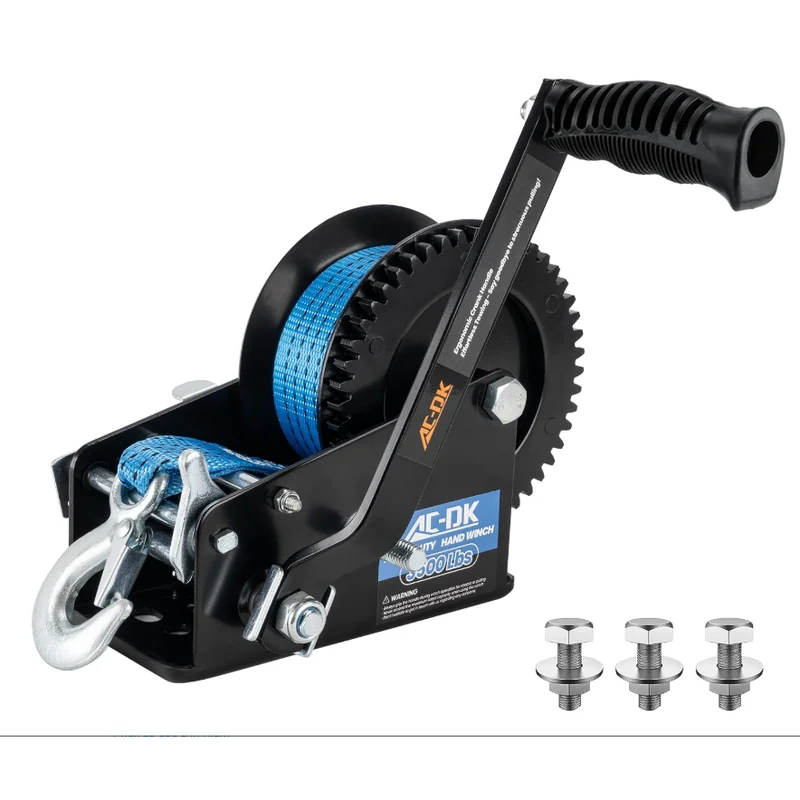
The AC-DK 3,500-lb Two-Speed Boat Trailer Winch is our heavy-duty value pick for boaters who want substantial rated capacity without immediately moving to an electric winch.
Its 3,500-pound rating is the highest among our manual selections, and its two-speed gearing gives you the option of faster retrieval or additional mechanical advantage when pulling resistance increases.
That can be particularly helpful with heavier boats, carpeted bunks, steeper ramps, or trailer setups where the final portion of retrieval requires noticeably more effort.
Why We Like It
The AC-DK combines high rated capacity, two-speed gearing, and a long strap at a price point that can make it attractive to boaters who need more capability but still prefer a manual system.
Key Features
- 3,500-lb rated capacity
- Two-speed gearing
- 4:1 and 8:1 gear ratios
- Approximately 32-ft polyester strap
- Two-way ratchet
- Heavy-duty steel construction
- Corrosion-resistant finish
Best For
Boaters who want higher manual capacity and two-speed gearing while keeping costs under control.
Pros
- 3,500-lb rated capacity
- Two-speed design
- Long strap
- Good specifications for the price
- No battery or electrical wiring required
Cons
- Less established marine brand than some long-standing trailer manufacturers
- Manual operation still requires physical effort
- Strap, gears, ratchet, and mounting hardware should be inspected regularly
3. Nilight 3,500-lb Electric Boat Trailer Winch — Best Electric
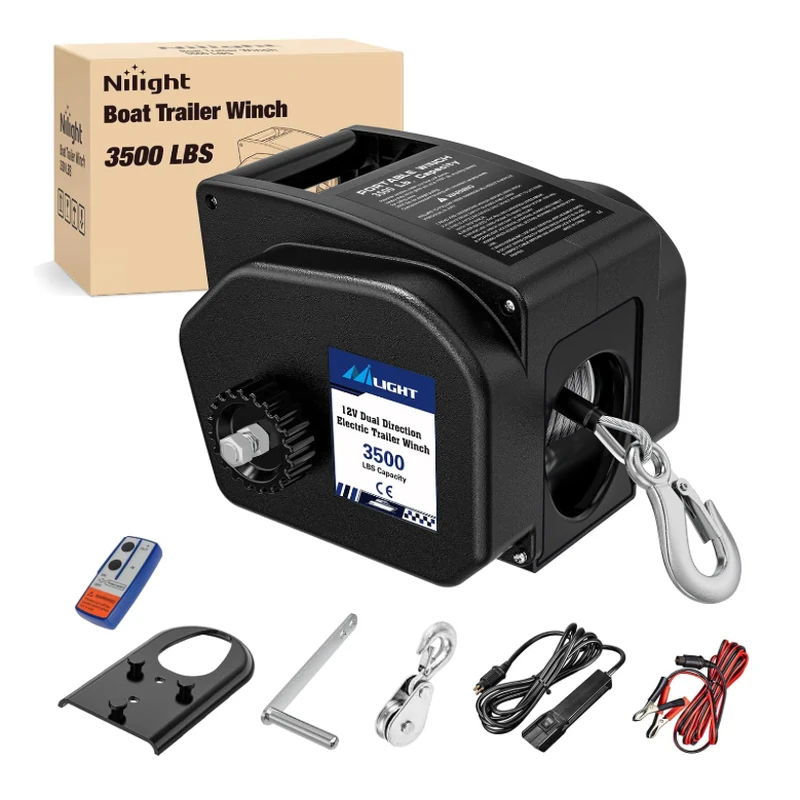
For boaters who want to reduce the physical effort required to load a boat, the Nilight 3,500-lb Electric Boat Trailer Winch offers an alternative to traditional hand-crank models.
Instead of relying entirely on manual cranking, the Nilight uses 12-volt power to assist with retrieval.
That can make an electric winch especially appealing for boaters who frequently launch alone, retrieve a heavier boat, or simply want an easier loading process after a long day on the water.
Remote operation can also make it easier to control the winch while maintaining a better view of the boat’s position on the trailer.
Why We Like It
The main advantage is convenience.
Electric operation can significantly reduce the physical effort involved in retrieval, while manual backup capability provides an alternative if electrical power isn’t available.
Key Features
- 3,500-lb rated capacity
- 12V electric operation
- Wireless and wired control options
- Synthetic line/rope configuration
- Manual backup capability
- Designed for boat trailer and towing applications
Best For
Solo boaters and anyone who wants to reduce the amount of manual cranking required during retrieval.
Pros
- Powered retrieval
- Reduces physical effort
- Remote-control capability
- Manual backup
- High rated capacity
Cons
- More complicated than a manual winch
- Requires a suitable 12V power source
- Electrical components require additional care around water
- Typically costs more than a basic manual winch
4. Camco 50000 2,000-lb Boat Trailer Winch — Best Budget
Not every boat needs a 3,000-plus-pound two-speed winch.
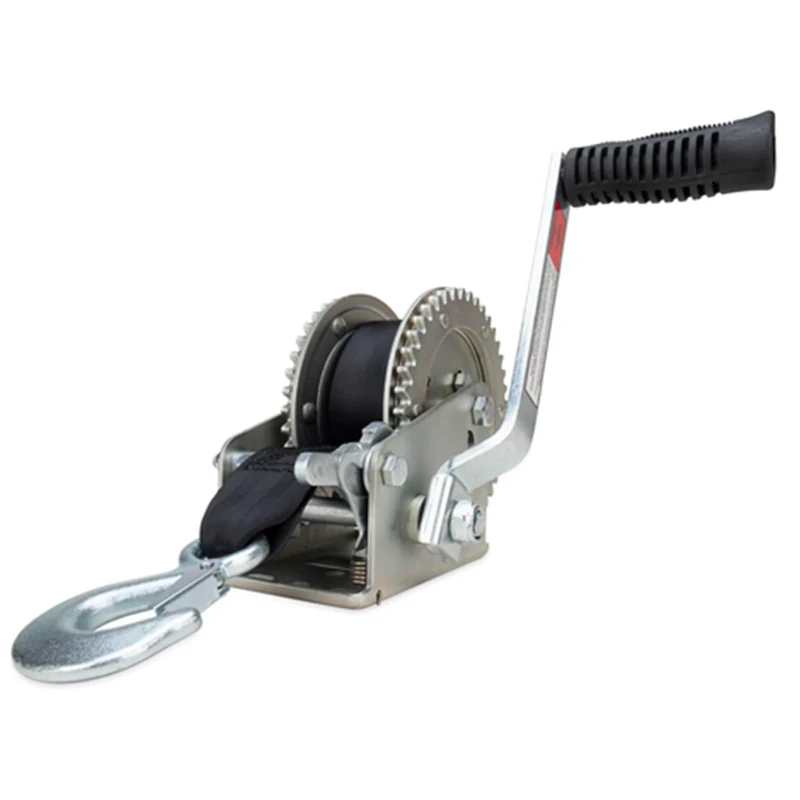
For smaller and lighter trailer boats, the Camco 50000 2,000-lb Boat Trailer Winch offers a straightforward and affordable alternative.
The Camco uses a simple manual design with a 4:1 gear ratio and includes a 20-foot polyester strap.
Its simplicity is part of the appeal. There is no battery connection to maintain and no electrical system to troubleshoot at the ramp.
For an appropriately sized boat and trailer, it provides the basic functionality many recreational boaters need without paying for capacity or features they may never use.
Why We Like It
The Camco gives budget-conscious boaters an established product with a large amount of owner feedback instead of forcing them toward an unknown bargain winch simply to save money.
It’s also meaningfully different from our higher-capacity picks, giving smaller-boat owners a more appropriate option.
Key Features
- 2,000-lb rated capacity
- 4:1 gear ratio
- 20-ft polyester strap
- Two-way ratchet
- Heat-treated gears
- Zinc-plated construction
Best For
Smaller trailer boats and boaters looking for an affordable, straightforward manual winch.
Pros
- Affordable
- Simple manual design
- Polyester strap included
- Established product with substantial owner feedback
- Good option for lighter boats
Cons
- Lower rated capacity than our other selections
- Single-speed operation
- Shorter strap than the larger two-speed models
- Not intended to replace a properly sized heavy-duty winch
How to Choose the Right Boat Trailer Winch
Choosing the right boat trailer winch involves more than comparing maximum capacity numbers.
The amount of pulling force required depends on the boat’s loaded weight, trailer design, bunk or roller resistance, ramp angle, gearing, and other factors.
Start With Your Loaded Boat Weight
Use the approximate loaded weight of your boat rather than relying only on the manufacturer’s dry hull weight.
Remember to account for equipment such as:
- Engine
- Fuel
- Batteries
- Fishing equipment
- Electronics
- Coolers
- Safety equipment
- Anchors
- Other gear normally carried aboard
Then compare that weight and your trailer configuration with the winch manufacturer’s sizing recommendations.
A steep ramp or carpeted bunk trailer can create more resistance than a gently sloped ramp and a roller trailer.
Don’t choose a winch that barely meets your expected requirements simply because its advertised capacity looks adequate.
Manual vs. Electric Boat Trailer Winches
Manual winches remain a good choice for many recreational trailer boats.
They’re relatively simple, don’t require a battery connection, generally cost less, and have fewer electrical components exposed to the marine environment.
Electric winches trade some of that simplicity for convenience.
An electric model may make sense if you frequently launch alone, retrieve a heavier boat, want to reduce physical effort, or have difficulty repeatedly operating a hand crank.
Neither design is automatically better.
The right choice depends on your boat, trailer, launch conditions, frequency of use, and personal preference.
Single-Speed vs. Two-Speed Winches
Single-speed winches use one fixed gear ratio.
For lighter boats and relatively easy loading conditions, that may be all you need.
Two-speed winches provide another level of mechanical advantage.
One setting can retrieve the strap more quickly, while the lower gearing makes it easier to continue pulling when resistance increases.
That can make two-speed models especially useful with heavier boats and bunk trailers.
Boat Trailer Winch Strap vs. Cable
Polyester webbing straps are common on recreational boat trailers because they’re relatively easy to handle and inspect.
They also don’t develop the sharp broken wire strands associated with aging steel cable.
Inspect a winch strap regularly for:
- Fraying
- Cuts
- Abrasion
- UV deterioration
- Damaged stitching
- Hook damage
- Excessive fading or wear
Steel cable can still be appropriate for some applications, but it also requires regular inspection for corrosion, kinks, crushed areas, and broken strands.
Whatever line type you use, follow the winch manufacturer’s requirements and replace damaged components before they fail.
Check the Strap Length
Strap length can be easy to overlook.
Your winch line needs to reach the bow eye from the winch drum when the boat is positioned for retrieval while still maintaining the proper amount of line on the drum.
The winches in this guide use different line lengths, so measure your trailer setup before buying.
Consider Freshwater vs. Saltwater Use
Trailer winches operate in a harsh environment.
Water, road spray, rain, UV exposure, and salt can attack the winch body, gears, ratchet mechanism, fasteners, handle, and mounting hardware.
If you routinely launch in saltwater, corrosion resistance deserves extra attention.
Rinse trailer equipment with fresh water after saltwater use and inspect the winch regularly for corrosion or damaged components.
Boat Trailer Winch Safety
A boat trailer winch is primarily a loading and positioning device.
It should not be your only means of securing the boat during highway transportation.
Once the boat is correctly positioned on the trailer, use the appropriate bow safety connection and transom tie-downs for your setup.
Before launching or retrieving, inspect:
- Winch strap, rope, or cable
- Bow hook
- Ratchet mechanism
- Mounting bolts
- Winch stand
- Bow stop
- Safety chain or secondary connection
- Tie-down hardware
Never stand directly in line with a heavily loaded strap, rope, or cable.
Frequently Asked Questions
What size boat trailer winch do I need?
Start with the loaded weight of your boat, including the engine, fuel, batteries, and gear, and then follow the winch manufacturer’s recommendations for your application.
Trailer type and ramp conditions also matter.
Carpeted bunks and steeper ramps generally create more resistance than roller trailers and shallow ramps, so avoid choosing a winch based on dry hull weight alone.
Is a two-speed boat trailer winch worth it?
It can be, particularly with heavier boats.
Two-speed gearing allows faster line retrieval when resistance is relatively low and additional mechanical advantage when the boat becomes harder to pull.
For a lightweight boat, a simpler single-speed model may be perfectly adequate.
Is an electric boat trailer winch better than a manual winch?
It depends on the application.
Electric winches reduce physical effort and can be convenient for solo loading and heavier boats.
Manual winches are simpler, generally less expensive, and don’t depend on an electrical source.
For many recreational boats, either design can work well when correctly sized.
Can I install a higher-capacity winch on my existing trailer?
Often, but don’t evaluate the winch by itself.
The mounting plate, winch stand, fasteners, bow stop, hook, strap or cable, and trailer structure all need to be appropriate for the loads involved.
A higher-capacity winch does not automatically increase the safe capacity of the rest of the trailer hardware.
How often should a boat trailer winch strap be replaced?
There isn’t one replacement schedule that works for every boat.
Inspect the strap regularly and replace it when you see significant fraying, cuts, abrasion, damaged stitching, UV deterioration, or other signs of weakening.
Frequent use and exposure to saltwater and sunlight can accelerate wear.
Should I use a winch strap or steel cable?
For many recreational boat trailers, a polyester webbing strap is convenient, easy to inspect, and comfortable to handle.
Steel cable may still be appropriate for certain applications but requires inspection for corrosion, kinks, and broken strands.
Always use line that meets the requirements of your particular winch.
Final Verdict
For most boaters looking for a capable manual upgrade, the Better Boat 3,200-lb Two-Speed Boat Trailer Winch is our top choice for 2026. Its combination of rated capacity, two-speed gearing, and a long strap makes it a versatile option for many trailer-boat setups.
For boaters who want additional manual capacity while keeping the system simple, the AC-DK 3,500-lb Two-Speed Winch offers strong specifications and good value.
If reducing physical effort is the priority, the Nilight 3,500-lb Electric Boat Trailer Winch provides powered retrieval and remote operation.
And for smaller boats where a higher-capacity two-speed model isn’t necessary, the Camco 50000 2,000-lb Winch is our budget pick.
Whichever model you choose, match the winch to your actual loaded boat, trailer design, and launching conditions rather than buying solely on the advertised capacity number.
If you’re upgrading the rest of your trailer setup, check out our Best Boat Trailer Accessories for 2026 guide for more equipment that can make launching, loading, and towing easier.
You can also explore our Boat & Trailer Gear section for additional trailer-related buying guides and equipment.
For other essential equipment before your next trip, see our Best Boat Anchors for 2026 and Best Boat Covers for 2026 guides.
As we continue expanding our Boat Trailering series, we’ll be covering boat trailer winch straps, electric trailer winches, winch sizing, loading equipment, and other trailer gear to build out this complete Boat Gear Pilot trailering resource.