The best boat anchors should match how and where you actually use your boat. An anchor that works well for holding a fishing boat over a sandy lake bottom may be completely different from what you want for stopping at a shallow sandbar or securing a personal watercraft near the beach.
Anchor style, bottom composition, boat size, water depth, storage space, and weather conditions all matter. Traditional fluke anchors remain popular because they can provide excellent holding power in sand and mud, while newer shallow-water anchors are designed specifically for beaches, sandbars, coves, and other areas where a conventional anchor may be unnecessary or inconvenient.
For this guide, we selected four different anchoring solutions for common boating situations. Whether you need a complete anchor kit for a fishing boat, a compact folding anchor, or something lightweight for shallow water, these are four options worth considering.
Affiliate Disclosure
Boat Gear Pilot participates in the Amazon Associates Program and the eBay Partner Network. We may earn a commission when you purchase through links on this page, at no additional cost to you. Our recommendations are based on product features, boating suitability, availability, and overall value.
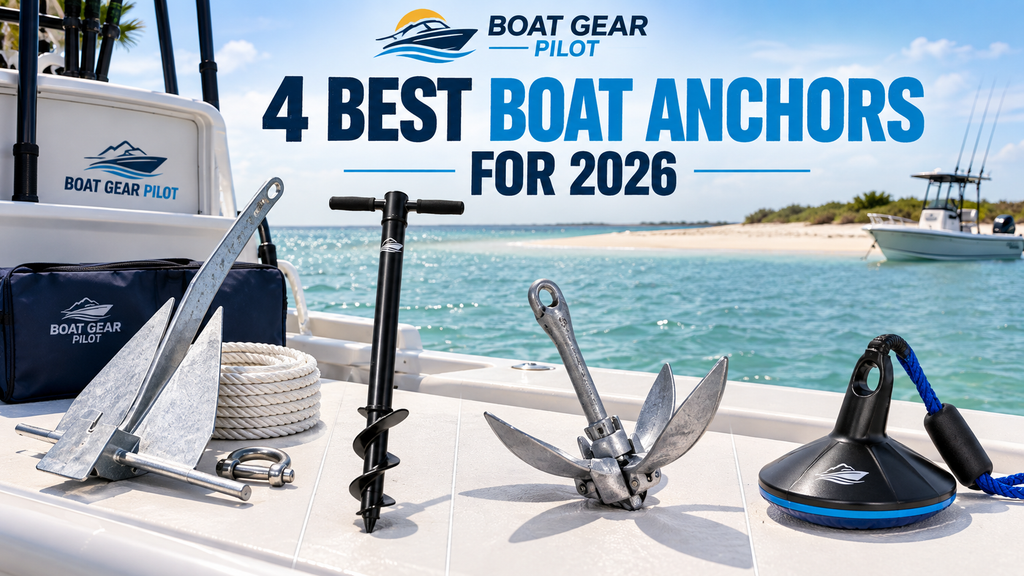
Quick Picks
Best Overall: SajoSolid 13-lb Danforth Anchor Kit
Best Shallow-Water Anchor: SandShark SuperSport 3.0
Best Folding Anchor: Seachoice 43780 Fold-and-Hold
Best for Small Boats & PWCs: SandShark Sport Anchor
1. SajoSolid 13-lb Danforth Anchor Kit — Best Overall
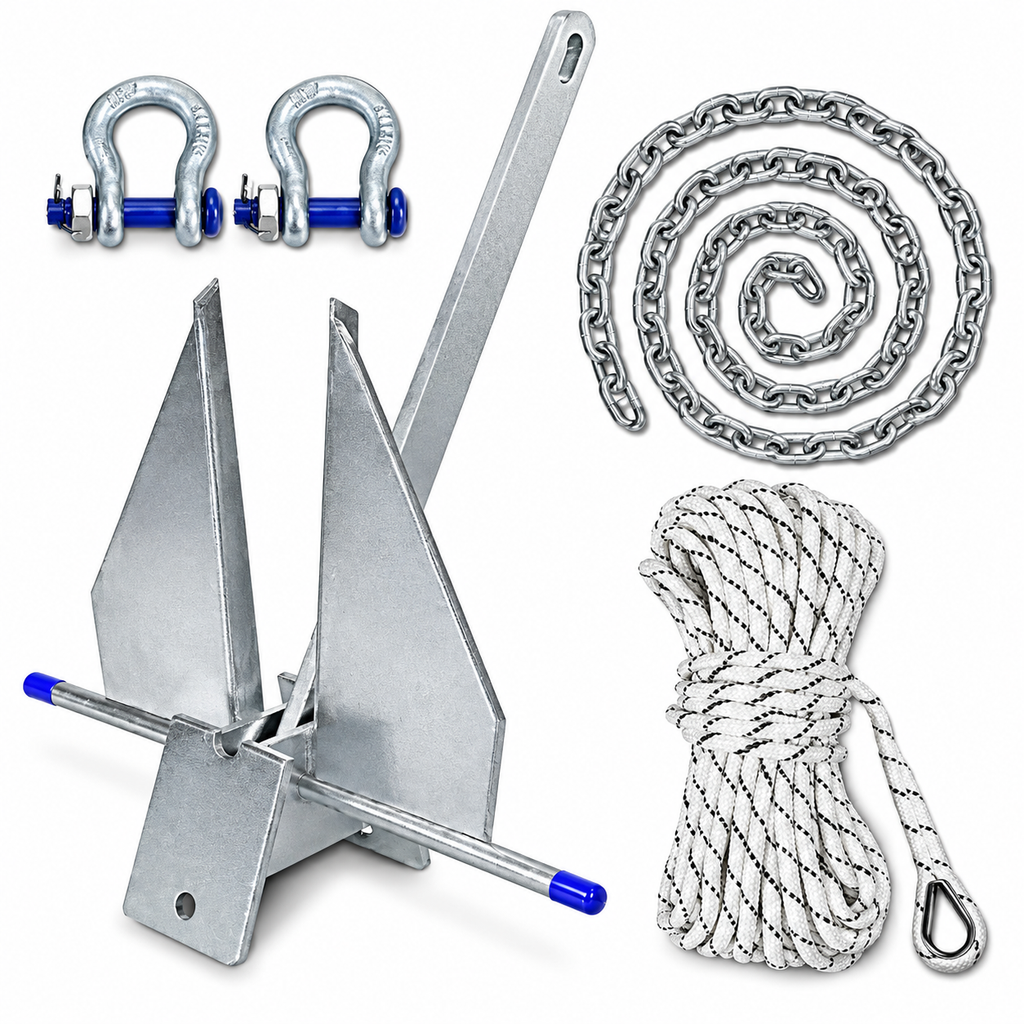
For boaters looking for a traditional anchoring setup rather than a specialty shallow-water system, the SajoSolid 13-lb Danforth-style kit is our Best Overall pick.
The biggest advantage is that this is intended as a complete anchoring package instead of just an anchor. The 13-pound fluke-style anchor is paired with approximately 100 feet of nylon rope, chain, and shackles, giving boaters the major components needed to build a functional anchor system.
A 13-pound fluke anchor is a useful size class for many mid-sized recreational boats. Comparable 13-pound fluke kits are commonly recommended for boats roughly 20 to 32 feet, and fluke-style anchors perform especially well in sand and mud.
Why We Like It
We like this setup because it solves more than one problem at once. New boat owners sometimes buy an anchor and later realize they still need appropriate rope, chain, shackles, and connection hardware.
A complete kit simplifies the process and gives recreational boaters a traditional anchoring system suitable for fishing, cruising, lakes, and many coastal situations.
Key Features
- 13-lb fluke-style anchor
- Designed for mid-sized recreational boats
- Approximately 100 ft of nylon anchor line
- Anchor chain included
- Shackles included
- Galvanized metal construction
- Suitable for freshwater and saltwater use
- Particularly useful over sand and mud
Best For
Fishing boats, pontoons, runabouts, and recreational boats needing a complete conventional anchoring system.
Pros & Cons
Pros
- Complete anchor package
- Strong holding design for sand and mud
- Includes rope and chain
- Good choice for larger recreational boats
- Easier than sourcing every component separately
Cons
- Requires more storage than a compact specialty anchor
- Fluke anchors are not equally effective on every bottom type
- Heavier to deploy than shallow-water pole anchors
2. SandShark SuperSport 3.0 — Best Shallow-Water Anchor
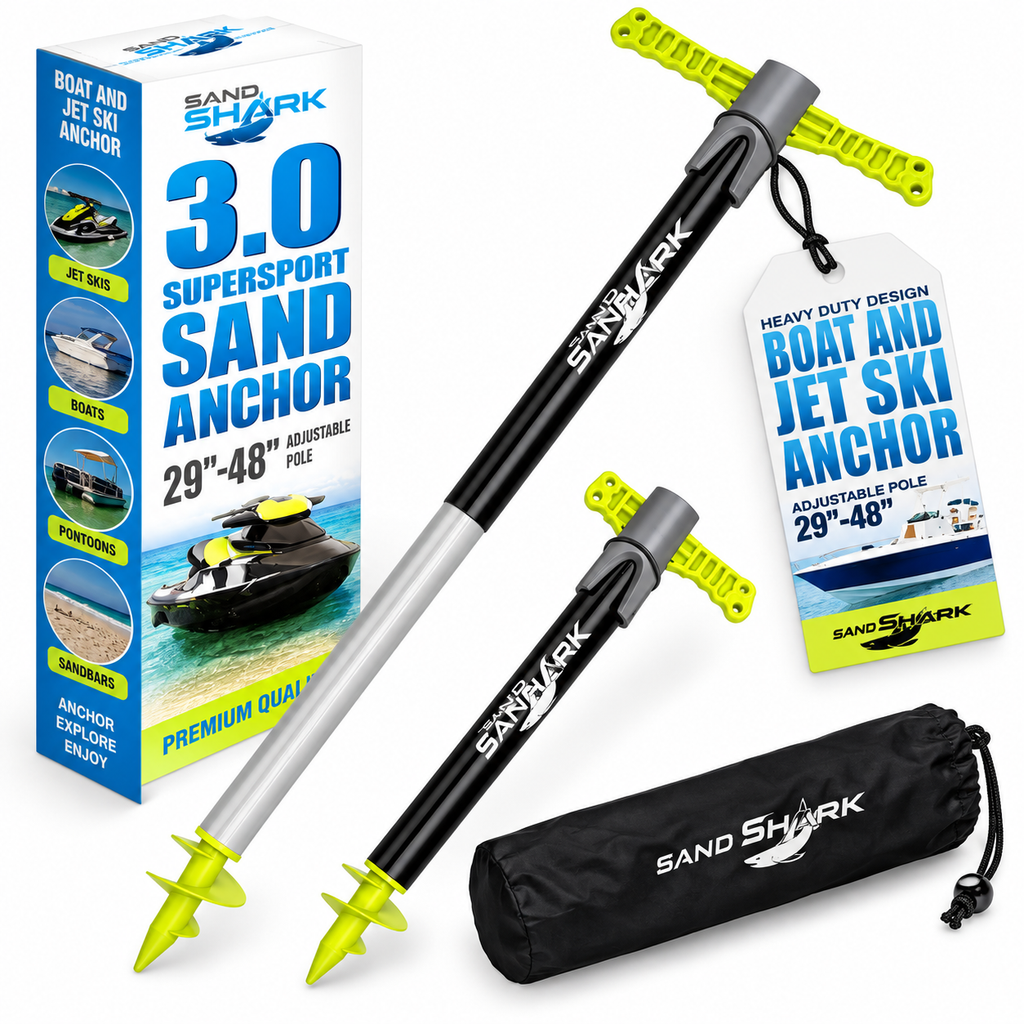
The SandShark SuperSport 3.0 is very different from a traditional weighted anchor. Instead of relying primarily on weight and flukes, it uses an auger-style design that screws into the bottom.
That makes it particularly interesting for boaters who spend time at sandbars, beaches, shallow coves, and other areas where you can physically reach the bottom.
SandShark says the SuperSport 3.0 weighs approximately 5 pounds and telescopes from roughly 29 to 48 inches, making it substantially easier to handle and store than many conventional anchors.
Why We Like It
If you regularly stop at sandbars or shallow beaches, a heavy traditional anchor isn’t always the most convenient solution.
The SuperSport is lightweight enough to handle easily, compact enough for smaller storage compartments, and specifically designed to secure a boat in shallow sandy areas.
It’s a specialty anchor rather than a replacement for your primary deep-water anchor, but within its intended environment it makes a lot of sense.
Key Features
- Auger-style shallow-water design
- Approximately 5 lb
- Telescoping construction
- Adjusts from roughly 29 to 48 inches
- Designed for sand and shallow bottoms
- Compact for storage
- Corrosion-resistant marine construction
- Suitable for boats, pontoons, and PWCs
Best For
Sandbars, shallow coves, beaches, swimming areas, and boaters who frequently anchor in water shallow enough to reach the bottom.
Pros & Cons
Pros
- Very lightweight
- Easy to deploy in shallow water
- Compact telescoping design
- No heavy chain to lift
- Well suited to sandbars
- Easier to store than many traditional anchors
Cons
- Intended primarily for shallow water
- Not a substitute for a conventional offshore/deep-water anchor
- Bottom conditions matter
3. Seachoice 43780 19-lb Fold-and-Hold Anchor — Best Folding Anchor
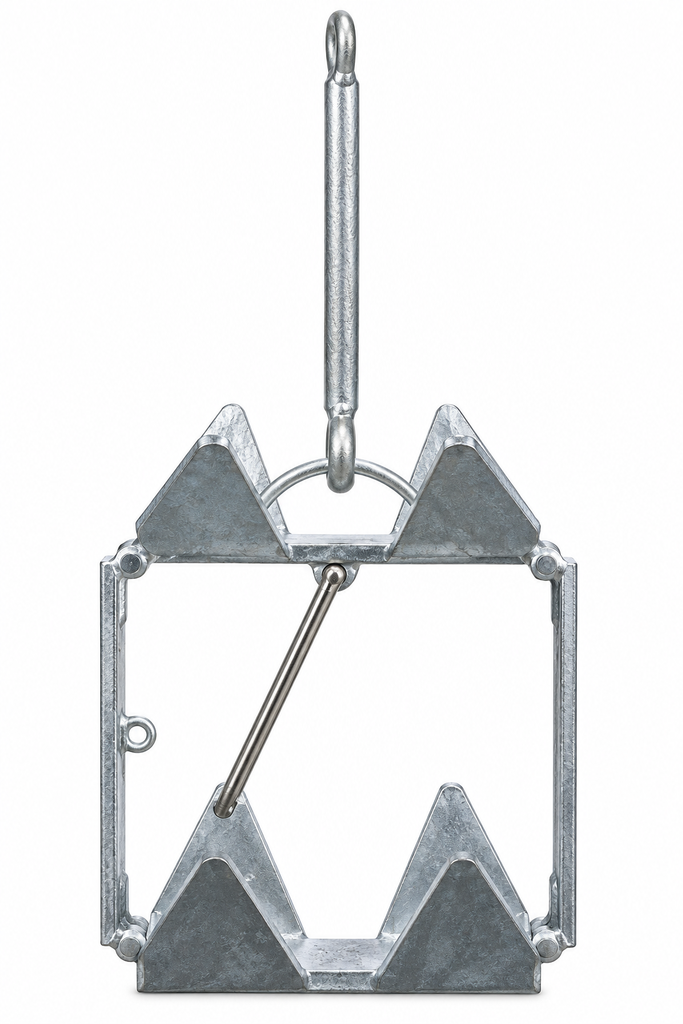
Storage space can disappear quickly on a fishing boat or recreational boat, which is one reason folding anchors remain attractive.
The Seachoice 43780 Fold-and-Hold gives boaters a relatively heavy 19-pound anchoring option while using a design that can be folded down when it isn’t needed.
That makes it particularly useful as either a primary anchor on an appropriately sized boat or a secondary anchor kept aboard for backup or specialized situations.
Why We Like It
The major advantage here is straightforward: storage efficiency.
Traditional anchors can be awkward pieces of equipment. Their flukes and arms consume space and can catch on other gear.
A folding design makes the anchor easier to store in a compartment, anchor locker, or other limited space while still giving you a substantial 19-pound piece of anchoring equipment when deployed.
Key Features
- 19-lb anchor
- Folding design
- Compact storage configuration
- Designed for recreational marine use
- Useful as a primary or secondary anchor
- Suitable for boats where storage space matters
- Heavy-duty construction
Best For
Boaters who want a substantial anchor but don’t want a permanently bulky anchor occupying valuable storage space.
Pros & Cons
Pros
- Folding design saves space
- Substantial 19-lb weight
- Convenient as a backup anchor
- Easier to store than many fixed anchors
- Established marine brand
Cons
- Heavier to lift than lightweight anchors
- Moving/folding components require attention
- Still needs properly sized rode and hardware
4. SandShark Sport Anchor — Best for Small Boats & PWCs
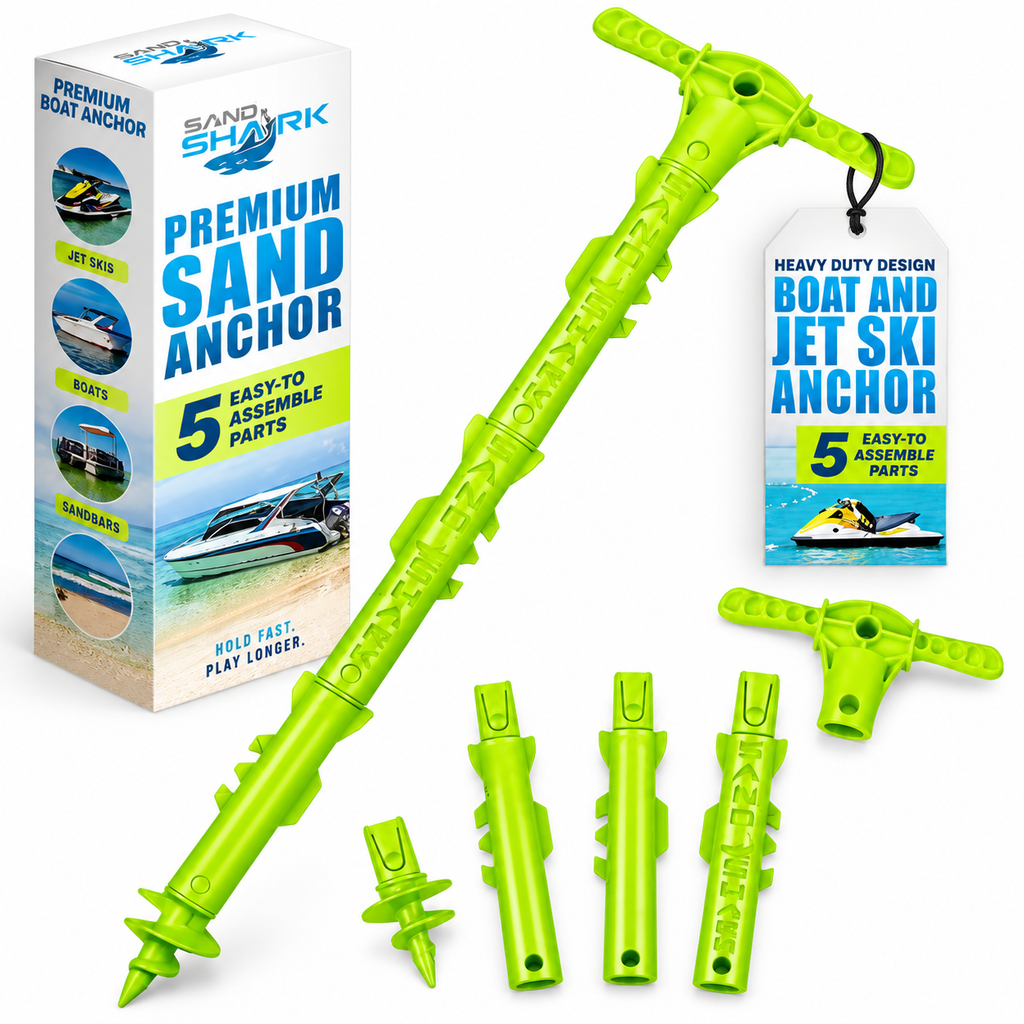
The SandShark Sport takes the shallow-water anchor concept and makes it even more portable.
SandShark lists the Sport at approximately 4 pounds and describes it as a three-piece anchor that breaks down for storage. The company recommends it for boats and pontoons up to about 21 feet, along with personal watercraft and other smaller vessels used in shallow water.
Rather than dropping a heavy anchor over the side, the Sport uses an auger-style tip that is twisted into sand or another suitable shallow bottom.
Why We Like It
PWCs and smaller boats often don’t have much room for bulky anchoring equipment.
The Sport is lightweight, breaks apart into compact pieces, and comes with a storage bag. That makes it much easier to keep aboard a jet ski, small fishing boat, or runabout.
For boaters who spend most of their recreational time around beaches and sandbars, it can be a very convenient secondary anchoring solution.
Key Features
- Approximately 4 lb
- Auger-style anchor
- Three-piece construction
- Breaks down for storage
- Storage bag included
- Corrosion-resistant construction
- Designed for shallow-water use
- Recommended for PWCs and boats up to approximately 21 ft
- Designed primarily for sandy and soft shallow bottoms
SandShark says the Sport is intended primarily for shallow water around 6 feet deep or less.
Best For
Jet skis, PWCs, small fishing boats, runabouts, and boaters who regularly stop at sandbars or beaches.
Pros & Cons
Pros
- Extremely lightweight
- Breaks down for storage
- No rust-prone traditional steel anchor
- Good fit for PWCs
- Easy to transport
- Designed specifically for shallow-water recreation
Cons
- Specialty shallow-water product
- Not suitable as your only anchor for deep-water boating
- Requires a bottom where the auger can be driven securely
How to Choose the Best Boat Anchor
Choosing an anchor based only on price or weight can lead to poor performance. The better approach is to think about where you normally anchor, the size of your boat, bottom conditions, and whether you need a primary anchor or a specialty anchor.
Match the Anchor to the Bottom
Bottom composition is one of the biggest factors affecting anchor performance.
Sand and mud:
Fluke or Danforth-style anchors are especially popular for these bottoms because their large flukes can dig into the substrate and develop substantial holding power.
Rocky bottoms:
A different anchor geometry may perform better because traditional flukes can have difficulty penetrating hard or uneven surfaces.
Shallow sandbars and beaches:
Auger-style pole anchors such as the SandShark products can be extremely convenient when the water is shallow enough to physically screw the anchor into the bottom.
Choose the Correct Size
Anchor sizing shouldn’t be based only on boat length.
Boat weight, windage, current, expected weather, bottom composition, and whether the anchor is being used as a primary or secondary system should all be considered.
Manufacturer sizing recommendations are a useful starting point. For example, several 13-pound fluke-anchor kits are marketed for boats roughly 20–32 feet, assuming typical recreational conditions.
When conditions are unusually demanding, moving to a larger anchor can provide an additional safety margin.
Don’t Forget the Anchor Rode
The anchor itself is only one part of the system.
Your rode normally consists of rope, chain, or a combination of both. Chain near the anchor adds weight and abrasion resistance while helping the pull on the anchor remain more horizontal.
Nylon rope is commonly used because it provides stretch that can absorb shock from waves and boat movement.
Primary vs. Secondary Anchor
Many boaters benefit from carrying more than one anchor.
A conventional anchor can handle normal anchoring situations, while a specialized shallow-water anchor can make stops at beaches and sandbars considerably easier.
Having a second anchor can also provide backup capability if your primary anchor becomes damaged or lost.
Consider Storage
Anchor lockers vary dramatically from boat to boat.
Large fluke anchors can provide excellent holding power but may be awkward to store. Folding anchors and collapsible shallow-water poles are attractive when storage space is limited.
Always make sure the anchor and rode can be secured safely so they don’t move around while the boat is underway.
Frequently Asked Questions
What is the best boat anchor for sand?
Fluke or Danforth-style anchors are among the most popular choices for sand because their wide flukes can dig into the bottom and develop strong holding power.
For very shallow sandy areas and sandbars, an auger-style shallow-water anchor can also be extremely convenient.
What size anchor do I need for my boat?
The answer depends on more than boat length. Boat weight, windage, bottom type, expected weather, and manufacturer recommendations should all be considered.
Always consult the sizing guidance for the specific anchor you’re considering.
Do I need chain on my boat anchor?
Most traditional anchoring systems benefit from having chain between the anchor and rope.
Chain helps resist abrasion near the bottom and adds weight that can help maintain a favorable pulling angle on the anchor.
Are shallow-water anchors worth it?
They can be extremely useful for boaters who frequently visit beaches, sandbars, flats, and shallow coves.
However, they should generally be viewed as a specialized anchoring tool rather than a substitute for a properly sized conventional anchor when boating in deeper water.
What is the difference between an anchor and an anchor kit?
An anchor is simply the anchor itself.
A complete anchor kit normally adds the rode and connecting hardware, which may include rope, chain, shackles, and thimbles.
Buying a complete kit can make setup easier for boaters starting from scratch.
Should I carry two anchors?
For many boaters, carrying a second anchor is a good idea.
It provides backup if the primary anchor is lost or damaged and lets you choose different anchor types for different bottom conditions.
What is the best boat anchor for a fishing boat?
There isn’t one anchor style that is ideal for every fishing boat.
For fishing over sand or mud, a properly sized fluke-style anchor is often a strong choice. Boats frequently stopping in shallow water may also benefit from carrying an auger-style shallow-water anchor as a second system.
Final Verdict
The best boat anchor is the one that matches your boat, bottom conditions, and the way you spend time on the water.
For most recreational boaters who want a conventional setup, the SajoSolid 13-lb Danforth Anchor Kit is our Best Overall pick because it combines a traditional fluke-style anchor with rope, chain, and the major hardware needed to put the system to work.
For boaters who spend time at beaches and sandbars, the SandShark SuperSport 3.0 provides a much lighter and easier shallow-water alternative.
The Seachoice 43780 Fold-and-Hold is a strong option when storage space matters, while the lightweight SandShark Sport makes the most sense for PWCs and smaller boats that frequently operate in shallow water.
Whichever anchor you choose, make sure it is sized appropriately for your boat and intended for the bottom conditions where you normally operate.
Looking for more boating gear? Check out our guides to the Best Marine Binoculars for Boating, Best Portable Boat Fuel Tanks, and Best Boat Coolers for Boating.
Anchoring equipment is only part of protecting your boat. When securing your vessel alongside a dock or another boat, properly sized fenders are equally important. See our Best Boat Fenders for 2026 guide for five recommended options.